Showing posts with label philosophy. Show all posts

20 August 2014

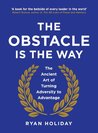
Review of The Obstacle is the Way

The Obstacle is the Way: The Timeless Art of Turning Adversity to AdvantageThe Obstacle is the Way: The Timeless Art of Turning Adversity to Advantage by Ryan Holiday
My rating: 5 of 5 stars

I enjoyed this book, even though it isn't super deep. It is not your typical self-help book. I like how Holiday pulled from so many different great thinkers and people who have done things even in the face of tremendous adversity.

Some books are great because they introduce you to other books. This is such a book. I was introduced to Lincoln's Melancholy: How Depression Challenged a President and Fueled His Greatness, which I am thoroughly enjoying; The River of Doubt: Theodore Roosevelt's Darkest Journey, which I will soon be thoroughly enjoying; among others. Also, I got a good taste of Marcus Aurelius's Meditations and the writings of Epictetus. Yeah, I know, I shoulda already read them a looong time ago, but I haven't, so leave me alone or I'm telling Mom!

If you are interested in Stoicism, or if you just seem to have an inordinate amount of hardship, this is a good introduction to the kind of thinking that can help you develop the toughness of mind to, like, conquer the world (if that is your desire); or, it can help you just to get through your normal daily pile of smelly stuff without getting too much on you.

My way of looking at the rocks and hard places that I regularly encounter has changed. When I was younger, I was more resilient; now that I'm older, I needed a little reminder that I can handle things if I have the right attitude.

If you're already perfect and resiliency is your superpower, then you can probably skip this book. If, however, you need a little refresher course on how to handle the small stuff that makes you sweat whether you want to or not, then you could do worse than giving Holiday's book a quick read.

Get yourself a copy, here:
The Obstacle Is the Way: The Timeless Art of Turning Trials into Triumph
View all my reviews

04 May 2014

Review of Heretics: The Creation of Christianity from the Gnostics to the Modern Church by Jonathan Wright

Heretics: The Creation of Christianity from the Gnostics to the Modern ChurchHeretics: The Creation of Christianity from the Gnostics to the Modern Church by Jonathan Wright
My rating: 5 of 5 stars

This is an informative book, well-written and with an easy to read style/voice. It's good enough that I plan to re-read it, hoping to get even more out of it. I'm very interested in Church/Christian History as a whole, but especially enjoy reading history from an objective perspective. I don't get the sense that I'm reading a particular brand of Christianity's history, or even a history with too much slant on it, i.e. it’s not making up my mind for me, but simply presenting information and allowing me to think and make conclusions for myself.

According to Wright without heresy, orthodoxy may never have been solidified. He writes, “Heresy certainly helped define orthodoxy, but it still required a bold leap to equate that orthodoxy with the only reputable version of Christianity” (82). This last statement is a thought I have often had, but have not been able to put into words as clearly as Wright does. Wright is not giving a prescription, here, but rather a description. Again, he lets the reader come to their own conclusions.

Wright presents representative arguments from all sides before, during and after the seemingly all-important councils. The arguments on the Trinity vs. Unitarian concepts; the god-nature vs. human nature of Jesus Christ. He discusses how the Holy Spirit slowly changed from an almost afterthought to one third of the Trinity. He gives information on the various heresies and the people who were accused of holding them and what happened to them. And, as Wright states, “we are reminded that the line between orthodoxy and heterodoxy was always very thin” (104). This is even more true today.

According to others (e.g. Ross Douthat) heresy is now almost the norm, having overcome the most staid and staunch orthodoxy. Wright takes a different thought, writing that “[i]t is hard to reach a firm conclusion. Was there really more heresy during the medieval era, or simply more attempts to seek it out and eradicate it?” (135). I tend to be between the two ideas, that there is heresy. I think it’s prominent because of modern knowledge (particularly scientific knowledge). In order to keep people interested, the leaders in churches have to avoid deep theological issues. In order for people to feel congruent, they have to hold unorthodox ideas. Some orthodox concepts are quite hard to jibe with what is experienced on a daily basis. I have a feeling that most of what we call Christianity, today, would have been considered heresy in the Middle Ages. Wright may agree. He writes, “There was no more conspicuous example of medieval Christianity’s inability to neatly define the borders between heresy and orthodoxy than the Beguines, who were welcomed, at first, by paeans of support and ended up being thrown into the flames” (142).

One good thing about the tolerance of/freedom of religion we enjoy, at least in most Western countries, few are dying for their unorthodox beliefs and thoughts. “It has recently been calculated that, across Europe in the sixteenth century, as many as five thousand people were legally executed for their supposedly heterodox religious beliefs” (Wright 181). That is progress, but others (again, Douthat) seem to bemoan this change. I’m probably reading to much into those ideas, but I prefer heresy to mass killings of supposed heretics.

Wright also presents the concept “In one of the more notable plus ca change moments of European history, the persecuted quickly became the persecutors” (187). This continued throughout church history.

I appreciate how Wright gives equal ink to both sides of the issue; he keeps a pretty objective voice throughout and makes it easy for the reader to come to their own conclusion. He also has a good scholarly apparatus: i.e. notes, bibliography, index.

I thoroughly enjoyed this book and recommend it highly. If you are interested in history in general or Church/Christian history in particular, this is an excellent book to increase your knowledge of this subject.


View all my reviews

02 May 2014

Review of Living Beyond Terrorism by Zieva Dauber Konvisser

The first thing that I noticed and something that kept coming up is that the book is a testament to “the strength of the human spirit” (xxiii).  Another recurring thought is that of resilience.  I will attempt to write this review without giving away too much of the book.  There is just so much that touched me and I want to do the work justice.  It is an important book and I hope it gains a wide readership.  It’s a book about hope and healing, and that is for anyone. 

Konvisser has an wonderful writing voice; while her book is well-researched and scholarly, the style and the voice keeps it accessible for the lay reader.  In my humble opinion, she does an excellent job of writing a book for both audiences without skimping on either side.  She also includes representatives from several groups of people: Jewish-Israelis, Arab-Israelis, and others from other countries who have made Israel their home.  While presenting the stories of these people, she attempts to keep it about them and how they have coped with, and how their lives have changed since, the traumatic events of terrorist attacks; she attempts to keep the book from being political.  And, she does a pretty good job of that, too. (xxxiii)

Konvisser wants to make it clear, by letting these people tell their own stories, that these survivors are human beings, not merely numbers we hear on the evening news.  Real people with hopes, dreams, loves, worries, fears, and lives and people who love them and whom they love.  She writes: “By telling and retelling their stories, we celebrate their lives as people—as human beings—not simply as players in a larger story or as numbers.  By telling their stories we bear witness” (xxvii).  The book is an anthology of the stories of not victims but, survivors (this is an important distinction for them) of terrorist attacks: which include shootings, car bombings, and suicide bombings.  Konvisser considers this text, this work, as a tribute and a responsibility. 

It seems that those in this area of the globe, are experiencing something similar to the state of the United States before the Civil Rights Movement in the 1960s.  Violence obviously is not working, and maybe they should try non-violence.  This book could be helpful in establishing the dialogue that can bring these two groups of people closer to peace. There is a bulleted list of “Lessons Learned” in the preface, which according to the author was developed from all the stories of the survivors and of the bereaved.  I won’t include it here, but recommend the reader to not skip the preface and so miss this important part of the work.

It’s not just Jewish-Israelis who are the victims/survivors; the Arab people living in this area also suffer: some are killed, some maimed and many are treated like criminals just for being Arab and being in the area of a terrorist event.  So, their trauma is double maybe even tripled or quadrupled.  While most of the people’s stories talk about the post-traumatic stress that they suffered, they also depict post-traumatic growth.  This latter, the way I understand it, would be like a kind of awakening brought on by the trauma and the recovery from it.

Even in the midst of the terrible events and the subsequent recovery, most of the stories presented here show amazing amount of hope.  The survivors talk about people asking why they keep living there, to which they answer, “This is my house and my family…” In a sense, “How can I leave my home?”  These survivors realize what’s important: family, friends, sense of place and belonging, and not letting the terrorists win. (264)  The survivors also talk about increased gratitude, along with a fear of returning to the place of the attack. (266)  This realization of what’s important and gratitude are also recurring concepts in these stories.

For the Arabs, there was a distancing by Jewish colleagues and a feeling of being under suspicion. (21) This is unfortunate, because the survivors were just as much targets of the terrorist attacks as their Jewish counterparts.  After years, they still struggle to deal with the after-effects, trying to be strong. (23)

The take-home seems to be that even if we never have the misfortune of experiencing a terrorist attack, we can learn ways of thriving when we face other traumatic events, or loss. (262)  Somehow, the perpetrators and retaliators have to realize that the violence is not solving their issues.  It seems the terror works for a short time, but only a short time.  The survivors will not let the fear win, so the terrorism loses its venom.  As one survivor says, “I had a new chance, a new life, to be more or less whole” (41), and “In the beginning it has to destroy you in order for you to survive” (42). 

This is a book about surviving, and in many cases flourishing, even after being involved in some of the worst events a person can imagine: terrorist attack.  The atrocities take their toll, but the survivors, at least those who share their stories here, come out stronger and with a great appreciation of life. 

I highly recommend this book to anyone interested in terrorism and dealing with it; trauma and healing after trauma; war and survival.  It has given me a new perspective on my own problems, making them seem almost non-existent in comparison.  However, neither Konvisser nor the story-telling survivors ever trivialize the trauma of others.  They demonstrate that it is significant and people can get through it.  I hope many readers find hope in this book, or at the very least, that they gain a new perspective on the world around them.

09 April 2014

Review of Ellipses ... by Danel F. Griffin

EllipsesEllipses by Danel F. Griffin
My rating: 5 of 5 stars

This is a fantastic debut novel. It has travel, adventure, literature, the Marx brothers and philosophy for good measure. It's been a while since I read it, and until I get my books out of storage, I won't get a chance to re-read it, but I just realized that I never wrote a review back then.

Griffin has a fresh voice and an interesting writing style. There is one chapter that just keeps fighting it's way back into my remembrance, and when you read it, you'll know which I mean (that's right, no spoiler alert!)

The characters were well written and could have been friends of mine from my college days; the situation and action are believable and shows Griffin's love of film by being very cinematic, i.e. it was very easy to visualize the things happening in the scenes. And, it was difficult to put down.

The best advice I can give is: read it and see what you think.


View all my reviews
Get a copy here:
Ellipses
and Danel's second novel:
Spiral's Edge

31 March 2014

Review of Understanding the Mystery of the Cross

Understanding the Mystery of the Cross: We Died at a Tree; God Gave Us Life at a TreeUnderstanding the Mystery of the Cross: We Died at a Tree; God Gave Us Life at a Tree by Mike Beecham
My rating: 5 of 5 stars

This is a well-written book on a very important area of Christian theology; it's also a great contribution to Christian theological writing, overall. While the topic/teaching is deep, Beecham clearly expounds on the meaning of the Crucifixion, and what that means for the Christian in their everyday lives and in the idea of salvation.

Mike Beecham writes with clarity and authority, developing this teaching and making it accessible to any reader while maintaining orthodoxy. I hope to see more books from him in the future.

I would recommend this for anyone interested in an excellent explanation of the Crucifixion and what that means in overall Christian theology/doctrine and belief.

View all my reviews

Visit the book's site for more info or to get a copy: Understanding the Mystery of the Cross
Update! The book is available on Kindle, now!
Get a copy here:
Understanding the Mystery of the Cross

27 January 2014

Review of Volume 1 of Modern Buddhism: The Path of Compassion and Wisdom

Modern Buddhism: The Path of Compassion and Wisdom - Volume 1 SutraModern Buddhism: The Path of Compassion and Wisdom - Volume 1 Sutra by Kelsang Gyatso
My rating: 5 of 5 stars

This is a good overview and practical manual for learning to walk the Buddhist path. It's similar to The Words of My Perfect Teacher: A Complete Translation of a Classic Introduction to Tibetan Buddhism (Sacred Literature Trust Series) , but this has more actual examples of meditations to use in daily practice.

(It is Volume 1 of 3, all of which were free on Amazon.com at the time I got my copy.)

If you are even a little interested in Buddhism in general, and/or Tibetan Buddhism in particular (esp. as it has evolved in our time and in the "West"), this is an excellent place to start.

It covers several levels, which I have only found similarly in the Dalai Lama's Becoming Enlightened . Here they are laid out in a way that was more clear to me.

View all my reviews

Get a copy here:

15 December 2013

I Choose to Live in Happiness

Life is too short to get caught up in other peoples' negativity.  Someone will always try to make you feel inferior, to feel like a loser, to feel like you are stupid.  It is up to you to allow these things to make you feel inferior, or like a loser, or to feel stupid.  Your thoughts are what will make you feel positive or negative, angry or not.

You can control your mind and you can train it to be positive in the face of the barrage of negativity from those who believe they are better than you, but are in reality hypocrites, because they don't even live up to their own professed values that they accuse you of failing to live up to.  And, yes, I ended that sentence with a preposition!

I will be happy and I will win!  Happiness comes from within.  I choose to let that happiness have the prominent place in my life.

I will live in love and compassion.  I will help as many other people to find happiness as I am able.  I know that I will not, indeed: CANNOT, help everyone.  But, I will in all cases, be myself.  If you can handle that, I appreciate it; if you can't, I will do it anyway!

I choose a happy life! :-D

Peace!

06 November 2012

If I Was a Prayin' Man

If I was a praying man, I would spend this day on my knees crying out to whatever divinities there may be; my petitions, like incense before the altar, without ceasing, would rise up to the very nostrils of the gods.

What would be the theme of my prayers?  What would be the cry of my heart?

Gott im Himmel, pleeeeease let Obama win this election, for the sake of our children and our children's children; for the sake of all the women who will be in bondage to cruel, unforgiving laws in regards to their own bodies; for the sake of this fragile planet which we call home; and for the sake of my sanity, because, frankly, that Romney guy gives me the creeps.
Amen.

But.... since I am not a praying man, I will just ask all of you that read this, if it's not too late, please think about the long-term outcome of this election; not just the next four to eight years, but on into the future.  Please, think about any women in your life, including your wife, daughter(s), mother, sister(s) and friends: think about how the Republicans' plan will basically plunge us into a near Middle Ages as concerns women and how they are treated; they really should be allowed to make their own decisions when it comes to their own bodies.  Please, don't let the rhetoric against Obama make you choose poorly; and Romney is a poor choice.

Am I saying Obama is the best President in the history of the United States?  No.  But, I am saying that he deserves another four years to finish the plans he started, and to clean up the mess that was left us from the Bush administration.  Also, I am saying that we should not go backwards, by choosing another president after the order of W.

Peace!  I'm going to vote!


Please, Think About It

31 October 2012

What is Love, Really?

The word love is thrown around, misused, abused and often misunderstood.  One of my biggest pet peeves, for example, has to do with one of the most popular uses of the word: i.e. "We made love."  It makes me crazy because people say it even when love, per se, is not involved.  Why must they use the word euphemistically?  Why can't they just say, "We had sex"?  I won't go on that rant just yet...  I'll save it for the post I do on eros (ἔρως); whenever that is.  

I would like to look at the types of love (more in a moment) in different ways and in different places: literature, symbols, ritual, sacred writings, spiritual/mystical writings, philosophy, and many, many more!  Yeah, that might happen.

I am not a Christian, but I have, over the years, thought many times about a sermon[*] I heard once (when I was Christian): the subject was the types of love: agape (ἀγάπη), philia (φιλία), storge (στοργή) and eros (ἔρως).  It was one of my favorites and it keeps coming back to me.  It's just a good topic; the world needs love, of whatever kind, right?  True love, I believe is about commitment: this is apropos with regard to any of these types of love.  All of them come down to being committed to the other person.  Anyone that's not you is an other (I guess I shouldn't open that topic here), so commitment is necessary.

After deciding I wanted to dwell on the subject of love for a few, I searched for, found and am currently reading C. S. Lewis’s book, The Four Loves, which covers this topic; I'll try to quote from it from time to time and hope that others find it as interesting as I do.  

What really interests me in this study is that “storge” (στοργή) is not in the New Testament.  I searched The Analytical Lexicon to the Greek New Testament [1]The Complete Vocabulary Guide to the Greek New Testament [2], and Strong's Exhaustive Concordance [3]; none of them have it.  So, I thought that perhaps it was a Platonic word, being that much of Christian doctrine was merged with Plato’s philosophy during the Middle Ages. 

Doing a little search online, I found that the word “storge” (στοργή) was used eight times by Flavius Josephus in his Antiquitates Judaicae (Antiquities of the Jews).  A tie is held, as far as usage goes, by Aelian, whose work I don’t know, but it is also used eight times in his De Natura Animalum (On the Nature of Animals).  Next, it is used six times by John of Damascus, of whom I also know nothing, in his Vita Barlaam et Joasaph (The Life of Barlaam and Joasaph). 

Several others, including Aristotle in his Metaphysics, use the word four or fewer times.  It is interesting that it is not in Plato, but is in a few of the early Church fathers: Saint Basil, Bishop of Caesarea, Epistulae (Letters), John of Damascus, mentioned already, Eusebius in his Historia ecclesiastica (Church History).[4]  So, here, I guess, with the early Church fathers we can see how it eventually made it to us.  There is the possibility that we could have acquired this word, as “affection,” from Josephus, but it is most likely that it came through the Church doctrines which have not changed all that much over the centuries, even if there have been major splits and disagreements among the various sects of Christianity during that time.

This makes me want to intensify my Greek and Latin studies…. 

Maybe I'll look at storge (στοργή) in my next post (which most likely will be in December), then work my way through the others and hopefully learn something along the way.  These may come slowly.  That sounds confident, doesn't it?  Anyway, please don't hold your breath waiting for the next post on this topic. 

Also, I want to be very frank here: I am going to participate in the NaNoWriMo challenge during the month of November, so right now I have nothing planned to post during the month.  I may post something, but I don't plan to.  And, I may not even do an entire series on love, but will sporadically post about it.  As I do with everything, right?  Like I said, don't hold any breath.  An interest hits me and I run.  Sometimes, the interest is sustained, other times, it's not.  

Till next time ... 


[*] This sermon was given by Mike Beecham.
[1] William Mounce
[2] Warren Trenchard
[3] James Strong
[4] http://www.perseus.tufts.edu/hopper/resolveform?type=start&lookup=storgh&lang=greek and: Word frequency information for στοργή:  http://www.perseus.tufts.edu/hopper/wordfreq?lang=greek&lookup=storgh%2F


17 July 2012

Agnostic Seeking


"The important thing is not to stop questioning."
- Albert Einstein

For awhile now I have called myself an atheist.  I’m probably more of an agnostic, because I still look for something outside myself and something that could be called a “spirituality” (yet, paradoxically without spirits or other super-natural beings).  That being said,  I still believe there are no gods, goddesses, divine beings, spirits, ghosts, demons….  There is no way to be absolutely certain, one way or the other, I know, but from my experience (which is no more than most religious believers use to argue their points for those things), the evidence is stacked against their existence.  So, on my agnostic scale, I lean more toward atheist than theist (in all its many forms). 

Understand, I don't scorn religions, belief systems or faith; and I especially have nothing against believers.  I simply seek; I delve into questions on morality, on good and evil (and what those ideas may or may not mean), on whether there is life after death (e.g. eternal life, reincarnation, metempsychosis), and on why very bad things sometimes happen to seemingly very good (or innocent) people. 

I seek answers to these questions in science, literature (sacred and profane), art, current and past world events, conversations with friends and family, and in movies.  Some questions are unanswerable in our existing state of knowledge and awareness, others are trivial and/or unconvincing. All the same, I still ask the questions.

09 July 2012

The Responsibility of Freedom


I tend to lean toward Existentialism in my philosophy of life.  So, when I came across this site: Freedom, Responsibility, and Agency, earlier, I had to let others know about this.  This is not the first time I have felt compelled to remind myself and others of the responsibility that comes with freedom.  As a matter of fact, I wrote a blog post about it, which can be read here. 

It was nice to find others that think the way I do in regards to this.  When I read the opening paragraph, I immediately felt as if someone had reached into my mind and pulled the thoughts out and put them into words:
Freedom, from an existential perspective, cannot be separated from responsibility. With freedom comes responsibility. Yet, it is common for many people to seek freedom while trying to avoid responsibility. While, at times, it appears that people may be able to succeed at this, there remains a psychological consequence. This consequence is often not very noticeable, but may find expression through guilt, anxiety, depression, or even anger.
The website makes a distinction between existential freedom and political freedom, such as the freedom of speech.  However, I think they are closely connected, though many people think of American political freedoms as god-given rights which should not be subject to responsibility in any way.  In my post I discussed comments (which I see as a form and example of the freedom of expression, but also as a violation of this existential idea of responsibility), but, of course, responsibility goes beyond that.  However, from reading comments, one can often get a good idea of the way in which people are shirking their responsibility, while exercising their freedom of expression.  

Closely related to this idea is the misconception that has been prevalent in recent years concerning the word “responsibility.”  Somehow, it has obtained the meaning of “the ability to respond.”  Well, it might mean that, but in its truer sense it has a meaning closer to “duty.”  And many people despise that word and that idea.  It sounds too much like work, or worse, slavery. 

Well, all it takes when it comes to our freedoms and the responsibility that goes with them, is a few seconds to ensure that what we say and do does not negatively affect others.  Can you do or say something that will hurt others?  Yes.  But, even if there are not legal consequences, even if they don’t retaliate in some way, you still have consequences.  And as the site mentioned above states, these are often mental or emotional problems. 

I have seen this happen.  I have experienced it in my own life.  I know people who think it is fine (they even brag about it) to just say whatever is on their minds, even if it is hurtful to someone else.  And, yes, they experience anxiety, depression and anger, and even though I am not a psychologist or psychiatrist I am able to tell that they struggle with guilt.  It’s in their speech.  It’s in their behavior.  It’s eating them alive. 

Here is the link to the website again: Freedom, Responsibility, and Agency Please take the time to at least skim it.  It is very informative and useful.

18 June 2012

Sacred/Profane/Spiritual/Secular

Sacred and profane are not mutually exclusive.  If you read sacred literature closely, you will see how it is often the profane that is set aside for destruction, i.e. set aside for the deity.  The meaning of "set aside for destruction" is to "make sacred."

Spirituality and secularism are exclusive.  Or are they?  I have often pondered this question.  I consider myself secular, humanist and atheist, but I also have an aspect to my way of seeing and being that I cannot label anything other than spiritual.  It's not that I believe in fairy tale creatures or deities or ghosts or anything else supernatural.  It is more like a connection to Jung's collective unconscious (a term I find amusing, because to be unconscious is like being, you know, passed-out/fainted/...errr, unconscious).  While I'm not sure how much I hold to this idea, I do have a need to spend time in quiet contemplation, which could be equated to the spiritual practice of meditation -- which I am also interested in.

But, and this is a big-O but, I don't believe that we are genetically spiritual.  Some scientists have found "evidence" of spirituality in the brains of subjects.  I think a good experiment to follow this, is to have atheists go through similar tests, but to use non-spiritual language, images, etc., to see what kind of result they come up with.

No 'God Spot' In Brain, Spirituality Linked To Right Parietal Lobe

“We have found a neuropsychological basis for spirituality, but it’s not isolated to one specific area of the brain,” said Brick Johnstone, professor of health psychology in the School of Health Professions. “Spirituality is a much more dynamic concept that uses many parts of the brain. Certain parts of the brain play more predominant roles, but they all work together to facilitate individuals’ spiritual experiences.”

There should also be the caveat here: spirituality does NOT by default mean YOUR specific brand of spirituality.  If there is a neuropsychological basis for spirituality, that does NOT mean there is a basis for a deity.  It is non sequitur to reach such a conclusion from this data.

I believe that people can have a form of, what could be called, spirituality without having recourse to deities or spirits.

I also believe that atheists can hold things as sacred.  What do atheists deem as sacred?  Sacredness usually connotes holiness or has a spiritual aspect, but can it not simply mean "set apart"?  They might hold their families as sacred, their friends, their intellect, even science.  They may hold the quiet beauty of the deep forest, or top of a mountain as sacred: not because it is inhabited by a spiritual being, but because it is a place where they can reach the deepest parts of themselves.

Atheists still have faith, right?  So why not sacredness?

Think about the things you consider sacred/profane; and about your outlook: is it more spiritual or secular?

NOTES:

Merriam Webster's Dictionary: Sacred - 1. a : dedicated or set apart for the service or worship of a deity <a tree sacred to the gods> b : devoted exclusively to one service or use (as of a person or purpose) <a fund sacred to charity>

26 December 2011

Being Changed by Literature

Change can be good, but it is not necessarily always easy.  Several changes that a person can experience may be barely noticeable: they wake up one morning and something is different.  Changes brought about by literature are usually not so quiet; at least not in my life.  Some of these changes I have instigated, others have been instigated for me by assigned readings in university, and others are serendipitous.

The changes that I have experienced in reading T. S. Eliot’s The Waste Land, for example, were of the latter kind.  I picked it up on purpose, but simply to distract myself.  It ended up being the focus of my 60 page senior thesis for the B. A. in English Literature.  Because of that one moment, the one choice to read something for the sheer distraction of it, I have stumbled onto the concentration for my future literary pursuits.  I still have more to say about it, lots more.  And, I really hated The Waste Land the first few times I read it; I thought to myself, “How can people call this good?”  But, now, I call it good!

Albert Camus changed the way I look at life in general.  I would say that the changes that have happened in my life since first reading his works were self-instigated.  I purposely and purposefully chose his Myth of Sisyphus with change in mind.  What happened was not so much an actual outright change, but a merging and an upgrading of my thinking.  I found that I already shared several of his thoughts and ideas, but was unable to articulate them and that he had been kind enough to put them in writing.  Others of his ideas were not mine, but I agree with them and now they are.

The reading that I have been doing lately has both intrigued and bothered me.  It is of the assigned variety.  It is mostly philosophical in nature, which I have not had much experience with.  Well, I should rephrase that.  I have read literature that is philosophical, but have not read much systematic philosophy and then attempted to read literature through it.  Some of these works are difficult, and my initial response is dislike or distaste.  The dislike is not because of the difficulty, nor because they are philosophy or philosophical, but because they lack poetry—I am mostly referring to Kant.

I have read many things that are merely good, enjoyable; that I am glad to have read, but that I will most likely not read again.

Then, there are those works that initially I dislike, or even hate; yet, as I read them I realize that I am changing.  In these times, change is not comfortable.  My mind will not stop working on the new ideas.   I lose more sleep than usual.   The Waste Land, as I mentioned, is one of these works.

Soon, if the literature is strong I will begin to let the words become a part of my way of thinking.   But, this is a choice.  My choice.  I will not blindly believe; I absolutely refuse to call something good just because someone else does.  If I did that, I would lose respect for myself as I have often lost respect for others that do this; i.e. call something good because that is the popular consensus.

Some of the works I have been reading lately are not literature, but philosophy and literary criticism.  The professor raves about them and I was initially excited to be introduced to them; that is, until I read them.  I had a strong dislike to a few, but after thinking about them and discussing them, they are slowly moving into my “must read again and again” category.  And, several have given me ideas for expanding my research on Eliot.

Not only will I not call something good simply because that is the general consensus; I will argue, fight, declare my disgust of the work—if I do not like it.  I will, however, usually give the work a fair chance by reading it for myself.  Sometimes, but not many times, the work of literature will remain on my “do not like” list.  More often the work will become one of my favorites, and not merely because of my investment in it, but because of its investment in me.

Investment in literature is not something I take too seriously, nor is it something I take lightly.  I am serious about literature and the part it will play in my future; I will wrestle with a text as long as is necessary, if I believe that it is worth it.  I refuse to take any of it so seriously, however, that I am angered when others joke or have fun at the expense of the literature.  If there is no fun in it, I will not bother.  The day I lose pleasure in literature and its study is the day I find something else to be fill my time.

That does not mean that I will only read silly literature—how much of that is running around in the wild?  What I mean is that I will not let literature become something about which I cannot change my mind.  If it is good, I will read it, enjoy it, wrestle with it, write about it, but I will not let it be my holy text.  I have no holy text and will have none, thank you.  Nothing is sacred unless we make it sacred.

My mind is my mind and I will run it the way I want to run it.1 Literature does have an enormous impact on much of my thinking and my way of being.  However, I have no problem changing my mind if I think that what I am reading no longer suits me, or serves me.  Maybe I am fooling myself.  Maybe I just think I change my mind, when in reality it is another work of literature that has done it for me….


1. At least I think this way; I could be wrong and have no free will whatsoever.  I’ll have to keep reading the philosophers and get back with you on it.