Showing posts with label non-fiction. Show all posts

08 June 2015

Giant Ears That Do Not See

There are some books that grab me and don't let go. William Powers's Whispering in the Giant's Ear is such a book. It has something I can't quite point to, which gives it barbs that perfectly match hooking places in my mind. It's the star-shaped block, star-shaped hole idea. It reminds me of the idea that you sometimes meet someone you feel like you knew in a former life. Déjà vu-ish. Déjà voodoo.

As I read, Rod Serling's voice echoed up from the past. Twilight Zone music gently wafting on the breeze blowing in one ear and out the other. What is it about this book that feels so ... me?

I've never been to Bolivia, or even South America, but I have a strong desire to go. Not as an eco-tourist, or any other kind of tourist, but to ... I don't know what. The Tranquilo idea Powers mentions so many times sounds like my own mindset. Maybe I was born in the wrong place. Because in the US if you're not working, working, working like an insane ant ramped up on speed, then there's something wrong with you.

Yes, there is something wrong with me. I need a transplant stat! A transplant from here to La Paz (The Peace). I'm not romanticizing; but I am dreaming! I know the indigenous Bolivians aren't all living in grass huts in 100% harmony with Nature. But, even many of the city dwellers live by the idea of Tranquilo, according to Powers.

My life hasn't been particularly hectic, but I get uptight about all the uptightness around me. Powers shows me a different drummer to march to. Henry David Thoreau, John Muir, Edward Abbey, Ed Buryn, Annie Dillard, all marched to a similar drumbeat. Or maybe they just chilled in the shade of whatever tree they happened to be under and enjoyed the rhythm of life as it came.

A friend of mine used to say, "Go slow and things will go fast. Go fast and things will go slow." His meaning was that when we hurry we screw up and have to start over. Or, we start fumbling and tripping over our own feet. Or, we get a speeding ticket, which entails being stopped. So, you see, you get stopped and you're even later than you would've been if you had been driving the speed limit. A lot of wisdom in that idea.

From my ramblings so far, you may get the impression that Whispering in the Giant's Ear is only about Tranquilo. It's not. But unless you get that concept, some of the rest of what Powers discusses won't have the impact that it should. The Indians getting angry and doing things (which most norteamericanos would have expected from the outset) is in stark contrast to their normally laid back, peaceful ways. They had to learn to play by the giant's rules and, similar to Odysseus in the cave of the cyclops, use the giant's strength to save their lives and land.

This book makes me want to be a part of the things happening in other parts of the world. Places where big powerful rich countries try to tell small weak poor countries how life ought to be lived, how they ought to use and abuse the natural resources. Because, yeah, it has worked out great for the big countries hasn't it?

Not so much, to use a well-worn phrase. And cliché is exactly the role the big countries are playing. I want to join los indios and tell the big countries to go drill themselves! When will people learn that the whole friggin world does NOT belong to them?

I know, probably never. But, those of us who already think that way can keep raising our voices, our pens, our roadblocking bodies, our money and time. I may sound like I'm part of a cause, or like I'm part of a revolution. I'm not. I'm just a man who wants some beauty and oxygen and livable temperatures on this planet for future generations. Whether they are my blood relatives or not, we are related. We are all Earthlings.

09 April 2015

Review of Candice Millard's The River of Doubt: Theodore Roosevelt's Darkest Journey

Inspiring! And although it slows at times, it is a book I am already planning to re-read.

It's one of those books that makes me want to be "a doer of the word and not a hearer only." Yeah, there is mention of the hardship and the illness and the dangers. But, isn't that what adventure is? And, yes, it is probably beyond my physical limits and abilities; but, really, by the dragon and St. George, what is not?

We find it tiring to cross the room to change the channel on the TV. Here, Candace Millard gives us the harrowing TRUE story of a man going to great lengths, nearly to the greatest (yes, Roosevelt almost died down there on that doubt-shrouded river), to battle the melancholy that has hounded him so long. It's a kind of physik that is physical, medicine you cannot get from a bottle of pills filled at the local apothecary's shop. It almost kills him, this curative which he has prescribed himself. But, to paraphrase Nietzsche: it didn't kill him; it made him stronger.

Teddy Roosevelt had learned how to deal with doubt, especially self-doubt, at a young age. And that trip on the River of Doubt put every one of his lessons to the test. Maybe he was crazy to keep going. Maybe he was a little suicidal in his quest to pass this test. But, he was committed and he was determined to pass it.

Reading Millard's book is nowhere near the arduous journey it's subject undertook. In fact, it's a bit of a joy ride at times and if it gets overwhelming, you can feel free to mark your place and go get a sandwich and a glass of iced tea. Just a little warning, though: the book, the story, will call you back ere long and away you'll go to reach the end of The River of Doubt and to learn how Roosevelt and his adventure party reached the end of their River of Doubt.

20 August 2014

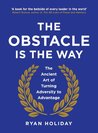
Review of The Obstacle is the Way

The Obstacle is the Way: The Timeless Art of Turning Adversity to AdvantageThe Obstacle is the Way: The Timeless Art of Turning Adversity to Advantage by Ryan Holiday
My rating: 5 of 5 stars

I enjoyed this book, even though it isn't super deep. It is not your typical self-help book. I like how Holiday pulled from so many different great thinkers and people who have done things even in the face of tremendous adversity.

Some books are great because they introduce you to other books. This is such a book. I was introduced to Lincoln's Melancholy: How Depression Challenged a President and Fueled His Greatness, which I am thoroughly enjoying; The River of Doubt: Theodore Roosevelt's Darkest Journey, which I will soon be thoroughly enjoying; among others. Also, I got a good taste of Marcus Aurelius's Meditations and the writings of Epictetus. Yeah, I know, I shoulda already read them a looong time ago, but I haven't, so leave me alone or I'm telling Mom!

If you are interested in Stoicism, or if you just seem to have an inordinate amount of hardship, this is a good introduction to the kind of thinking that can help you develop the toughness of mind to, like, conquer the world (if that is your desire); or, it can help you just to get through your normal daily pile of smelly stuff without getting too much on you.

My way of looking at the rocks and hard places that I regularly encounter has changed. When I was younger, I was more resilient; now that I'm older, I needed a little reminder that I can handle things if I have the right attitude.

If you're already perfect and resiliency is your superpower, then you can probably skip this book. If, however, you need a little refresher course on how to handle the small stuff that makes you sweat whether you want to or not, then you could do worse than giving Holiday's book a quick read.

Get yourself a copy, here:
The Obstacle Is the Way: The Timeless Art of Turning Trials into Triumph
View all my reviews

02 May 2014

Review of Living Beyond Terrorism by Zieva Dauber Konvisser

The first thing that I noticed and something that kept coming up is that the book is a testament to “the strength of the human spirit” (xxiii).  Another recurring thought is that of resilience.  I will attempt to write this review without giving away too much of the book.  There is just so much that touched me and I want to do the work justice.  It is an important book and I hope it gains a wide readership.  It’s a book about hope and healing, and that is for anyone. 

Konvisser has an wonderful writing voice; while her book is well-researched and scholarly, the style and the voice keeps it accessible for the lay reader.  In my humble opinion, she does an excellent job of writing a book for both audiences without skimping on either side.  She also includes representatives from several groups of people: Jewish-Israelis, Arab-Israelis, and others from other countries who have made Israel their home.  While presenting the stories of these people, she attempts to keep it about them and how they have coped with, and how their lives have changed since, the traumatic events of terrorist attacks; she attempts to keep the book from being political.  And, she does a pretty good job of that, too. (xxxiii)

Konvisser wants to make it clear, by letting these people tell their own stories, that these survivors are human beings, not merely numbers we hear on the evening news.  Real people with hopes, dreams, loves, worries, fears, and lives and people who love them and whom they love.  She writes: “By telling and retelling their stories, we celebrate their lives as people—as human beings—not simply as players in a larger story or as numbers.  By telling their stories we bear witness” (xxvii).  The book is an anthology of the stories of not victims but, survivors (this is an important distinction for them) of terrorist attacks: which include shootings, car bombings, and suicide bombings.  Konvisser considers this text, this work, as a tribute and a responsibility. 

It seems that those in this area of the globe, are experiencing something similar to the state of the United States before the Civil Rights Movement in the 1960s.  Violence obviously is not working, and maybe they should try non-violence.  This book could be helpful in establishing the dialogue that can bring these two groups of people closer to peace. There is a bulleted list of “Lessons Learned” in the preface, which according to the author was developed from all the stories of the survivors and of the bereaved.  I won’t include it here, but recommend the reader to not skip the preface and so miss this important part of the work.

It’s not just Jewish-Israelis who are the victims/survivors; the Arab people living in this area also suffer: some are killed, some maimed and many are treated like criminals just for being Arab and being in the area of a terrorist event.  So, their trauma is double maybe even tripled or quadrupled.  While most of the people’s stories talk about the post-traumatic stress that they suffered, they also depict post-traumatic growth.  This latter, the way I understand it, would be like a kind of awakening brought on by the trauma and the recovery from it.

Even in the midst of the terrible events and the subsequent recovery, most of the stories presented here show amazing amount of hope.  The survivors talk about people asking why they keep living there, to which they answer, “This is my house and my family…” In a sense, “How can I leave my home?”  These survivors realize what’s important: family, friends, sense of place and belonging, and not letting the terrorists win. (264)  The survivors also talk about increased gratitude, along with a fear of returning to the place of the attack. (266)  This realization of what’s important and gratitude are also recurring concepts in these stories.

For the Arabs, there was a distancing by Jewish colleagues and a feeling of being under suspicion. (21) This is unfortunate, because the survivors were just as much targets of the terrorist attacks as their Jewish counterparts.  After years, they still struggle to deal with the after-effects, trying to be strong. (23)

The take-home seems to be that even if we never have the misfortune of experiencing a terrorist attack, we can learn ways of thriving when we face other traumatic events, or loss. (262)  Somehow, the perpetrators and retaliators have to realize that the violence is not solving their issues.  It seems the terror works for a short time, but only a short time.  The survivors will not let the fear win, so the terrorism loses its venom.  As one survivor says, “I had a new chance, a new life, to be more or less whole” (41), and “In the beginning it has to destroy you in order for you to survive” (42). 

This is a book about surviving, and in many cases flourishing, even after being involved in some of the worst events a person can imagine: terrorist attack.  The atrocities take their toll, but the survivors, at least those who share their stories here, come out stronger and with a great appreciation of life. 

I highly recommend this book to anyone interested in terrorism and dealing with it; trauma and healing after trauma; war and survival.  It has given me a new perspective on my own problems, making them seem almost non-existent in comparison.  However, neither Konvisser nor the story-telling survivors ever trivialize the trauma of others.  They demonstrate that it is significant and people can get through it.  I hope many readers find hope in this book, or at the very least, that they gain a new perspective on the world around them.

19 April 2014

Review of Robert Wright's The Moral Animal

The Moral Animal: Why We Are the Way We Are: The New Science of Evolutionary PsychologyThe Moral Animal: Why We Are the Way We Are: The New Science of Evolutionary Psychology by Robert Wright
My rating: 5 of 5 stars

I was introduced to this book during a course on Buddhism and Modern Psychology. Wright covers a lot of ground in this well organized and tightly written book.

Wright doesn't hand down laws, saying "This is how it is," but rather leads with questions and tries to work out the answers based on Darwinian Natural Selection. This is not an easy task; so much is not available when examining the world from a purely materialistic point of view. When one is not allowed to give credit to supernatural, or even non-biological mental events, it really demands a serious and deep interrogation of the biological, chemical, and other physical causes of why people do the things they do. Wright uses several events from Darwin's life as examples, and in doing so makes both evolutionary psychology and Darwinian Natural Selection accessible to his readers.

If you're interested in morality, Darwin, evolutionary psychology, or why people do what they do, this is an excellent read.

If you're not interested in those topics, it's STILL and excellent read! I highly recommend it.

View all my reviews

18 April 2014

Review of Joshua Foer's Moonwalking With Einstein

Moonwalking With EinsteinMoonwalking With Einstein by Joshua Foer
My rating: 5 of 5 stars

Foer uses several examples of how these mnemonic techniques work, and compares/contrasts them to those few people who have unexplained super-memory because of brain damage or brain syndromes. He investigates and includes stories about several people who have such syndromes and are able to do amazing things with their memories, or in some cases, can't remember anything after a few seconds: i.e. they can't develop long-term memories.

Joshua Foer participates in the U.S. memory competition, being trained by one of the top Mental Athletes, as they are called.

Several mnemonic techniques are explained and shown through example. It may be a jump between some of these techniques and real-world application of them, but many can be used immediately in "the real world."

It was a fun read/listen, and if you're interested in the memory, memory competition, mnemonics, memory palaces, or anything like that, I recommend this book. Even if you've read Tony Buzan, Harry Lorayne, Gary Small, Cicero, and others' books on memory, this is a new view on an ancient topic.

Enjoy.

View all my reviews

Get yourself a copy, here:
Moonwalking with Einstein: The Art and Science of Remembering Everything

21 March 2014

Review of Devil's Highway

Devil's HighwayDevil's Highway by Luis Alberto Urrea
My rating: 5 of 5 stars

So many in the US complain about illegal immigrants, while forgetting that their ancestors once came to this country uninvited. And most of those who come, now, really don't want to; they have family back home and many of them can't find jobs, because the American corporations have pulled out and left few jobs and those that are available are worse than minimum wage here. Sadly, many of those who try to come to the US die in their search for a better life for them and their families.

This exposes the selfishness that often comes with abundance that many US citizens enjoy. All of us can gain perspective by thinking about the ordeals our ancestors went through so that we could enjoy freedom of religion and the abundance available in this country. And, in truth, there are people in this country who are so far from that abundance that they can't even afford to see it on TV. It's not helping them to keep the immigrants out. They don't have access to the jobs the immigrants are out for. The world is screwed up enough without our complaining about people trying for a better life. Many who complain, however, try to lump all illegal aliens into one group: drug and human traffickers.

I'm reminded of the way German-Americans, Japanese-Americans were treated during WWII, and the way many people of Middle Eastern descent were treated (are still?) after 9/11. It's fear--xenophobia! And it is sad and disgusting. Especially when it is those who are simply trying to pursue happiness or a little less sadness, or even a little more to feed, clothe and house their family.

These immigrants often die in a horrible way, crossing Hell trying to reach the Promised Land which despises them for no other reason than they aren't from here.

Yes, the drugs and crime are often part of it--but, NEWS FLASH! drugs and crime have been part of the culture of the US for a loooong time and it does NOT depend on illegal immigration to keep going.

This book gives names to a few of the hundreds that try to find a better life, it gives the outsider a view into the lives of the kinds of people they are, how they live, how they want what everyone wants: happiness and the chance to take care of their families. I can't imagine anything closer to Hell on Earth than what all these desperate men endured and what lead to many of them to their deaths. Luis Alberto Urrea also shows how our jobs are not really in danger of being all taken away by illegal immigrants; he gives the whole thing context in which to come to our own ideas about border crossing and immigration.

If you are interested in what goes on on the Mexican-American border; in what often happens to the people who try to cross into a better life; or in ways all this is handled by our respective governments, and what that means for citizens of both countries; this is a good read to has a few answers, while at the same time putting a face on the brave and desperate people.

View all my reviews
Get a copy here:
The Devil's Highway: A True Story

17 December 2013

Review of Profiles in Murder

Profiles In MurderProfiles In Murder by Russell Vorpagel
My rating: 4 of 5 stars

I read this out of curiosity for how profiling became a part of catching serial murderers, etc. The curiosity started, of course, when watching Silence of the Lambs, but was further fanned watching Criminal Minds and other such TV shows. If you are at all interested in the process of FBI profiling, this is a good place to begin reading about it. Vorpagel was one of the agents who first started profiling and brought it into regular practice by law enforcement.

View all my reviews

Get yourself a copy, here: