Showing posts with label fiction. Show all posts

31 May 2014

Review of Jorge Luis Borges's A Personal Anthology

A Personal AnthologyA Personal Anthology by Jorge Luis Borges
My rating: 5 of 5 stars

This is one of my favorite anthologies. I continue to re-read several of the stories, poems and essays. Borges was a master of the author-identity concept. Many authors attempt to spin an identity separate from the "real" them which is the identity they present to their public, to their readers.

Borges writes that he wants the works in this anthology to be representative of his work; he wants these works to speak for him.

I don't read Spanish, yet, so I can't say how close to the original these translations are, but they are wonderful to read and I imagine are very good.

If you're interested in identity in literature, Latin American literature, influence, or in literature in general, read this. I highly recommend anything by Borges, but like any literature, you have to read for yourself to truly to discover if you will enjoy it. And, with Borges, you should try to read a wide swath of his work, because it varies. That's what makes this a great choice for introduction to his work, it gives a taste of his fiction, poetry and essays (which, you may know are not always non-fiction).

Enjoy!

View all my reviews

Get yourself a copy here:
A Personal Anthology

25 May 2014

Early Review of Richard Jackson's Confessions of a Terrorist: A Novel

Confessions of a Terrorist: A NovelConfessions of a Terrorist: A Novel by Richard Jackson
My rating: 5 of 5 stars

Advanced Reader's Copy Review:

The night I began reading Richard Jackson's Confessions of a Terrorist: A Novel, I didn't stop before finishing a third of it, it was difficult to put it down. Part of this is the style, it is written in the format of a Top Secret transcription of an audio or video recording of an interrogation of a MI5 agent and a terrorist/militant. There are no chapter breaks, so it's easy to just keep right on reading and the content makes it hard to simply close it and put it down.

Jackson, with this novel, seeks to shake up his readers' preconceptions and notions concerning those labeled as terrorists by the media. That seems to be one of his few aims: to show that those so quickly tagged as terrorists are human beings, having people they love, who love them; and who want people to hear them. Jackson writes: “I have rarely found artistic or media depictions of terrorists that seemed authentic or which corresponded to the completely normal, often intelligent, complex and committed people I had personally spoken to” (319). He presents the terrorist in this light; i.e. the opposite of the way they are usually presented in films and the media.

The author wants to put the readers in the room during the interrogation, to help them ask tough questions. Jackson lives up to his goal, stated on the jacket copy, to blur the line between the interrogator and the terrorist. There are passages that could catch readers nodding their heads in agreement and then, catch them feeling a twinge of guilt for doing so.

I read that it is in the style of Mohsin Hamid's The Reluctant Fundamentalist. I agree with that in that it is a story that takes place in an intense conversation between two characters: one a Westerner, the other a suspected terrorist. There the similarity breaks down. Jackson's novel is presented as a trascript (as I've already stated), with anotations by those higher up the chain of command; annotations that the fictional authority writes to convince others to expunge parts of the recording and the transcription to cover their collective backsides. Jackson recommends those who are inclined, should try to find as much information as they can, and to talk to militants, if possible.

If you enjoyed The Reluctant Fundamentalist, or are interested in a different perspective view on the issue of terrorists and their behavior, I highly recommend this novel. The author writes, “A novel like this is a small step, but a necessary one, to tearing down the veil of ignorance which currently lies over most of what we currently say and do about terrorism” (322). He also includes a suggested reading list for those interested in knocking down that “veil of ignorance.” I plan to re-read this novel, and to work my way through Jackson's "Recommended Reading" list on terrorism and terrorists.

View all my reviews

Get the Kindle version, here (the hardcopy is due out 3 June 2014):
Confessions of a Terrorist

25 April 2014

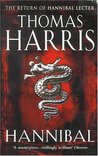
Review of Thomas Harris' Hannibal

Hannibal (Hannibal Lecter, #3)Hannibal by Thomas Harris
My rating: 5 of 5 stars

I kept putting off reading this, because I was afraid of being disappointed after having seen the film. I was NOT disappointed! It was very difficult to put down, and even though I was familiar with the plot and everything from the film, I still found myself wondering how it was going to turn out.

My desire to read this at this moment came mostly from my current writing project. I need some creepy bad guys, and of all in literature, film, etc., Hannibal is one of the first to come to mind in a tie with Cormac McCarthy's creepy creation: Anton Chigur in No Country for Old Men.

Looking forward to reading the rest of the Hannibal Lecter novels and hope they are as much of a charge as this one was.

View all my reviews

09 April 2014

Review of Ellipses ... by Danel F. Griffin

EllipsesEllipses by Danel F. Griffin
My rating: 5 of 5 stars

This is a fantastic debut novel. It has travel, adventure, literature, the Marx brothers and philosophy for good measure. It's been a while since I read it, and until I get my books out of storage, I won't get a chance to re-read it, but I just realized that I never wrote a review back then.

Griffin has a fresh voice and an interesting writing style. There is one chapter that just keeps fighting it's way back into my remembrance, and when you read it, you'll know which I mean (that's right, no spoiler alert!)

The characters were well written and could have been friends of mine from my college days; the situation and action are believable and shows Griffin's love of film by being very cinematic, i.e. it was very easy to visualize the things happening in the scenes. And, it was difficult to put down.

The best advice I can give is: read it and see what you think.


View all my reviews
Get a copy here:
Ellipses
and Danel's second novel:
Spiral's Edge

29 April 2013

Review of Don Winslow's The Power of the Dog

The Power of the DogThe Power of the Dog by Don Winslow
My rating: 5 of 5 stars

This is a long book, but the length (as Jane Smiley writes about in 13 Ways of Looking at the Novel) is a promise, not a threat.

The action is quick, the tension is high and the conflict is believable. There are neither purely good guys, nor completely evil bad guys. It seems like Winslow covered everything from family to feigned friendship, from faith to agnosticism, from obsession to oppression.

The War on Drugs plays a major role in this novel, as does the U.S.'s use of that travesty and failure to maintain a large distance from Communist countries: in other words, to keep them from moving in right next door.

Winslow's characters are both likeable and not. Some, I wanted to side with initially, only to rethink my loyalty later. It really is a great ride through the psychology of trying to reach a goal that may be, when all is said and done, unobtainable: e.g. the War on Drugs. It's like a war against dirt, it is never-ending and demands constant vigilance (which, if truth be told, is a waste of time, i.e. dirt will win). I'm not making a judgment on drugs (or on dirt, for that matter), but on the ways in which the U.S. has "tried" to stop the flow of those drugs. Billions of dollars have been spent, and many of those billions have ended up in the pockets of the heads of the very drug cartels that were the targets of this fiasco called a war.

Winslow does an excellent job of presenting the history necessary to tell his story without dragging in so much as to make it a boring read. He uses what is necessary, leaves out what isn't.

At the very least, this novel has made me think about the U.S. relations with our neighbors to the south in North, Central and South America. Was the War on Drugs really just a way for the U.S. to keep Communists from moving in right next door? Did the U.S. supply anti-communist fighters, who also happened to be part of the huge flow of drugs into and money out of the U.S.? Will you read this book and wrestle with your own questions about these issues?

That's all I can suggest: read it.

View all my reviews

Get yourself a copy here:
The Power of the Dog (Vintage Crime/Black Lizard)

23 April 2013

Review of The William Faulkner Audio Collection

The William Faulkner Audio CollectionThe William Faulkner Audio Collection by William Faulkner
My rating: 4 of 5 stars

Excellent readings of great stories. Just wanted to fill in some of the gaps in my Faulkner reading. Spotted Horses was the longest story here, and it was not disappointing. As it usually does, "A Rose for Emily" gave me the creeps. What a fantastic, creepy, weird story.

Faulkner is one of my favorite writers; that's not to say that I always like his content or his word choice, but that's neither here nor there, in my opinion. The man could write, stringing sentences together out of that not long ago time when things were not as pretty as they are now, making those sentences sing with repetition and other strategically placed rhetorical devices, causing those words to sing together in a wonderful dark beautiful sad Southern symphony.

Or something. If you like Faulkner, I recommend this audio collection, narrated by Debra Winger (remember her?), Keith Carradine, and Arliss Howard.

View all my reviews

Get yourself a copy, here:

06 March 2013

Review of The Devil All the Time by Donald Ray Pollock

The Devil All the TimeThe Devil All the Time by Donald Ray Pollock
My rating: 5 of 5 stars

Many times while reading The Devil All the Time I thought of Flannery O'Connor, especially her "A Good Man is Hard to Find." Also, a couple of times Joyce Carol Oates's short story, "Where Are You Going, Where Have You Been?" came to mind. Both excellent stories, and I recommend them highly if you like The Devil All the Time. It's not so much in the way Pollock writes, he's not a copy cat, but has his own style and voice. It's more the content that reminds me of those other stories.
The novel follows the life of Arvin Russell: beginning with him and ending with him. The other characters, though initially seeming to have nothing to do with Arvin, all slowly become part of his story. I got the feeling of a drain swirling, with whatever is caught in that whirlpool moving ever closer to the center; in this case the center is Arvin. The characters are well written and the tension is pretty good and the chapters are fairly short: which means "I can get one more chapter in before I go to sleep." Then, four chapters later, I actually close the book. It kept me interested.
Pollock's novel is set in and around Knockemstiff, Ohio, which was new to me. And some of the description reminded me of Cormac McCarthy's novels set in Tennessee, especially the shorter ones, like Orchard Keeper, Outer Dark, and Child of God.
I stumbled onto Donald Ray Pollock during some research for another author. I found that Pollock had won several awards and honors for his work and decided I would read something by him. I was not disappointed.
If you like the stories mentioned above, or other stories, such as The Wettest County in the World by Matt Bondurant (recently adapted into the film Lawless), or Faulkner or McCarthy, then I would recommend The Devil All the Time. Now, that's not to say that if you don't like any of those I have mentioned, you won't like this book. The best I can say is: read it and see for yourself.


View all my reviews

Get your own copy, here:

10 January 2013

Review of Outlining Your Novel: Map Your Way to Success

Outlining Your Novel: Map Your Way to SuccessOutlining Your Novel: Map Your Way to Success by K.M. Weiland
My rating: 4 of 5 stars

Most of the other reviews cover it pretty well. What I liked about this book is that K.M. Weiland presents several variations on the humble outline.

Most people hearing the word 'outline' immediately remember I. A. 1. a. and all the indenting and if you have A and B, then you must have C and on and on.... THAT kind of outlining is a nightmare, and there is no way I could use it to get my stories straight.

K.M. Weiland also includes interviews with authors who choose to outline or not and why or why not. It's a neat feature, but wasn't important for me in making a final decision to outline, but it did seem to make it "Okay" if you decide that outlines only work for you under certain conditions, say.

Aside from a few cliché phrases the book is well-written, which one would expect from someone who teaches writing. The author takes a descriptive tone, rather than a prescriptive one, when writing about outlines; that is always refreshing when reading writing books. Weiland also gives examples of the benefits, which according to her conclusion in this book, far outweigh the cost in time and frustration if an outline is not used, i.e. if one is a "pantser."

K.M. Weiland also has a helpful vlog, which is how I first learned about this book. Check it out.

View all my reviews

Get yourself a copy, here:

28 October 2012

Review of Cormac McCarthy's Child of God

Child of GodChild of God by Cormac McCarthy
My rating: 4 of 5 stars

Coming to this book, I knew only that the main character, Lester Ballard, had some strange ways, but I didn't know how strange until several chapters into the book. It is an interesting read; McCarthy has a way of making it seem dream-like: broken up, but still flowing together. I'm not sure that makes sense, but that's how it reads to me. He kept the chapters short, most being only a single scene: some shorter, some longer. The short chapters coupled with Lester's bizarre behavior keeps you turning the pages, not to mention the "need" to know what happens....

There is a strong link to mythology in most of McCarthy's work and this book is no different. There are trips to the underworld, shape-shifting and tragedy among other motifs.

Without giving away too much, I will say that this book is not for the faint of heart. If Nabokov's Lolita bothers you, then there is a possibility that this will, too. It isn't exactly the same as Lolita , but the deviance of Lester, the main character, is very pronounced as is that of Humbert Humbert. But, in the case of Child of God, Lester is not the narrator.

I wonder if you could still call Lester a protagonist? He does change, but not much. The reader gets the sense that he is depraved right from the beginning. It's the level, or depth, of his depravity that changes.

The writing itself will not disappoint fans of McCarthy. His prose, as always, is tight and musical; the critics like to call it poetic, which it is. It damn near sings. I give it four stars simply for the prose. The content gives me pause; that's not to say that we should ignore it, it's just more unsettling than a book with a happy-go-lucky attitude and a bright happy ending. McCarthy almost never has happy endings and this is no exception. He does have "just" endings on occasion, or endings in which those who deserve it get it, if you get my drift.

I will read it again, simply because I love McCarthy's writing and want to learn from him. If I were reading it as a reader only, once would be enough--maybe more than enough.

View all my reviews

If you need your own copy:

26 December 2011

Being Changed by Literature

Change can be good, but it is not necessarily always easy.  Several changes that a person can experience may be barely noticeable: they wake up one morning and something is different.  Changes brought about by literature are usually not so quiet; at least not in my life.  Some of these changes I have instigated, others have been instigated for me by assigned readings in university, and others are serendipitous.

The changes that I have experienced in reading T. S. Eliot’s The Waste Land, for example, were of the latter kind.  I picked it up on purpose, but simply to distract myself.  It ended up being the focus of my 60 page senior thesis for the B. A. in English Literature.  Because of that one moment, the one choice to read something for the sheer distraction of it, I have stumbled onto the concentration for my future literary pursuits.  I still have more to say about it, lots more.  And, I really hated The Waste Land the first few times I read it; I thought to myself, “How can people call this good?”  But, now, I call it good!

Albert Camus changed the way I look at life in general.  I would say that the changes that have happened in my life since first reading his works were self-instigated.  I purposely and purposefully chose his Myth of Sisyphus with change in mind.  What happened was not so much an actual outright change, but a merging and an upgrading of my thinking.  I found that I already shared several of his thoughts and ideas, but was unable to articulate them and that he had been kind enough to put them in writing.  Others of his ideas were not mine, but I agree with them and now they are.

The reading that I have been doing lately has both intrigued and bothered me.  It is of the assigned variety.  It is mostly philosophical in nature, which I have not had much experience with.  Well, I should rephrase that.  I have read literature that is philosophical, but have not read much systematic philosophy and then attempted to read literature through it.  Some of these works are difficult, and my initial response is dislike or distaste.  The dislike is not because of the difficulty, nor because they are philosophy or philosophical, but because they lack poetry—I am mostly referring to Kant.

I have read many things that are merely good, enjoyable; that I am glad to have read, but that I will most likely not read again.

Then, there are those works that initially I dislike, or even hate; yet, as I read them I realize that I am changing.  In these times, change is not comfortable.  My mind will not stop working on the new ideas.   I lose more sleep than usual.   The Waste Land, as I mentioned, is one of these works.

Soon, if the literature is strong I will begin to let the words become a part of my way of thinking.   But, this is a choice.  My choice.  I will not blindly believe; I absolutely refuse to call something good just because someone else does.  If I did that, I would lose respect for myself as I have often lost respect for others that do this; i.e. call something good because that is the popular consensus.

Some of the works I have been reading lately are not literature, but philosophy and literary criticism.  The professor raves about them and I was initially excited to be introduced to them; that is, until I read them.  I had a strong dislike to a few, but after thinking about them and discussing them, they are slowly moving into my “must read again and again” category.  And, several have given me ideas for expanding my research on Eliot.

Not only will I not call something good simply because that is the general consensus; I will argue, fight, declare my disgust of the work—if I do not like it.  I will, however, usually give the work a fair chance by reading it for myself.  Sometimes, but not many times, the work of literature will remain on my “do not like” list.  More often the work will become one of my favorites, and not merely because of my investment in it, but because of its investment in me.

Investment in literature is not something I take too seriously, nor is it something I take lightly.  I am serious about literature and the part it will play in my future; I will wrestle with a text as long as is necessary, if I believe that it is worth it.  I refuse to take any of it so seriously, however, that I am angered when others joke or have fun at the expense of the literature.  If there is no fun in it, I will not bother.  The day I lose pleasure in literature and its study is the day I find something else to be fill my time.

That does not mean that I will only read silly literature—how much of that is running around in the wild?  What I mean is that I will not let literature become something about which I cannot change my mind.  If it is good, I will read it, enjoy it, wrestle with it, write about it, but I will not let it be my holy text.  I have no holy text and will have none, thank you.  Nothing is sacred unless we make it sacred.

My mind is my mind and I will run it the way I want to run it.1 Literature does have an enormous impact on much of my thinking and my way of being.  However, I have no problem changing my mind if I think that what I am reading no longer suits me, or serves me.  Maybe I am fooling myself.  Maybe I just think I change my mind, when in reality it is another work of literature that has done it for me….


1. At least I think this way; I could be wrong and have no free will whatsoever.  I’ll have to keep reading the philosophers and get back with you on it.