Showing posts with label self-awareness. Show all posts

01 October 2015

Thinking Big and Cheesy Fun Stuff

David Schwartz's The Magic of Thinking Big is good pep-talk stuff, and it's funny in a corny way. Maybe it's the age of the book, maybe it's just me. Some of the concepts are familiar from other self-help books. Because they copied Schwartz, right? That's probably what he'd say. 
;-)

I listened to the audiobook and had some extra fun listening at slower speed. It made the author sound like he was three sheets to the wind, and it was that much funnier because he's also trying to sound serious and profound. It helped me remember those parts....

There are a few other narrators. Some do pretty well, others sound like they're reading, which they are ... so I guess that's okay? Just sometimes it tends to pull me out of the book.

And but so, a couple of concepts I don't fully agree with, which doesn't mean they're wrong. I may agree with them tomorrow. And, his illustrations aren't always PC. I don't care so much about that, but I'm more sensitive to those things than I used to be. That isn't stopping me from getting the good stuff out of this audiobook. Some of which can be used immediately.

I don't think The Magic of Thinking Big is for everyone. For example, chihuahuas wouldn't get much out of it, since they already think they're bigger than elephants. Almost anyone else can probably get at least one useful idea out of it and, often, that makes it worth the time to read or listen. I was reminded of several tools which I had sorta forgotten about, so I'm glad I listened to this audiobook.

In the end, you have to decide if you like it or not. Don't let others choose what you read. That's part of thinking big and being in control of your life: deciding what you want/need to read.

Benjamin Disraeli said, "Life's too short to be small."

So, go live big!

The Magic of Thinking Big was recommended by Tim Ferriss (fourhourworkweek.com).

20 August 2014

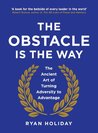
Review of The Obstacle is the Way

The Obstacle is the Way: The Timeless Art of Turning Adversity to AdvantageThe Obstacle is the Way: The Timeless Art of Turning Adversity to Advantage by Ryan Holiday
My rating: 5 of 5 stars

I enjoyed this book, even though it isn't super deep. It is not your typical self-help book. I like how Holiday pulled from so many different great thinkers and people who have done things even in the face of tremendous adversity.

Some books are great because they introduce you to other books. This is such a book. I was introduced to Lincoln's Melancholy: How Depression Challenged a President and Fueled His Greatness, which I am thoroughly enjoying; The River of Doubt: Theodore Roosevelt's Darkest Journey, which I will soon be thoroughly enjoying; among others. Also, I got a good taste of Marcus Aurelius's Meditations and the writings of Epictetus. Yeah, I know, I shoulda already read them a looong time ago, but I haven't, so leave me alone or I'm telling Mom!

If you are interested in Stoicism, or if you just seem to have an inordinate amount of hardship, this is a good introduction to the kind of thinking that can help you develop the toughness of mind to, like, conquer the world (if that is your desire); or, it can help you just to get through your normal daily pile of smelly stuff without getting too much on you.

My way of looking at the rocks and hard places that I regularly encounter has changed. When I was younger, I was more resilient; now that I'm older, I needed a little reminder that I can handle things if I have the right attitude.

If you're already perfect and resiliency is your superpower, then you can probably skip this book. If, however, you need a little refresher course on how to handle the small stuff that makes you sweat whether you want to or not, then you could do worse than giving Holiday's book a quick read.

Get yourself a copy, here:
The Obstacle Is the Way: The Timeless Art of Turning Trials into Triumph
View all my reviews

26 July 2014

Review of Stumbling on Happiness by Daniel Gilbert

Stumbling on HappinessStumbling on Happiness by Daniel Gilbert
My rating: 5 of 5 stars

This is an enjoyable book, at times laugh-aloud funny, but always serious. The topics he covers have been covered before, but I can't remember the last time I enjoyed reading about them so much.

Gilbert states that we often don't really know what makes us happy; that we often do things believing they will make us happy, but we misjudge because we base our future on the memories of our past. Often, those memories are unreliable. These thoughts aren't new, but the way Gilbert presents them is and it is worth the laughs you'll get to read them.

It did slow down a little toward the end, the density of the information building, but Gilbert does a good job of keeping it accessible and fun.

View all my reviews

Review of The Tools by Phil Stutz and Barry Michels

The Tools: Transform Your Problems into Courage, Confidence, and CreativityThe Tools: Transform Your Problems into Courage, Confidence, and Creativity by Phil Stutz
My rating: 4 of 5 stars

I am working through The Tools: 5 Tools to Help You Find Courage, Creativity, and Willpower--and Inspire You to Live Life in Forward Motion a second time. Initially, I thought that a lot of what Barry Michels and Phil Stutz teach here seems very New-Agey. After thinking about the Tools, I see that the Tools have cognates in Buddhism (esp. Tibetan Buddhism as it has come to North America). Active Love can easily be related to the practice of Tonglen: giving and receiving. A person first must receive love before it can be given.

Okay, you can say: "That isn't real, you're not really giving anything to anyone." I have to agree with that. I'm reminded of Elizabeth Gilbert and the "sending light and love" idea she writes about in Eat, Pray, Love. Even if you don't believe that you are sending actual love to someone, that is not the point. The point is: You are practicing loving that person; if you love someone, you have a harder time being angry (or sad, vindictive, or any other negative emotional state) toward/about that person. I have used Active Love more than any of the other Tools in this book and I can say that it has made it easier for me to stop renting space to those people who have "done me wrong." We often give too much thought to those people we dislike. I have no idea why. But, if you're like me, i.e. sick of doing that, then you'll read this book and use these tools to STOP DOING THAT!!!

What these tools do (only if you use them and use them use them) is give YOU more control over what YOU focus on. And, that is what the last tool focuses on: how to keep yourself using the tools. The authors say that these are not magic pills that you can use only once and then forget. Like anything that really matters, you will have to work at making the changes you want to make in your life.

Barry Michels writes that he was skeptical about the Tools initially, too, but that as he kept using them he realized how much they were helping him. Yes, there may be a time of uncomfortable repetition, but eventually the lack of faith is overcome by belief; and any self help program requires some degree of faith (in my humble opinion).

The authors recommend really sticking to the program, really giving it your all; they recommend not trying them once and then, immediately jumping on to another program and then, to another. As the writers argue is what is often done in consumerist societies: always looking for a magic pill, whether it's weight-loss, money-making, time-management, or whatever.

I have had some success with these tools. Does that mean that you'll have success with them? I have no idea. As usual, all I can say is: read it and use them and see for yourself.

Get yourself a copy, here:
The Tools: 5 Tools to Help You Find Courage, Creativity, and Willpower--and Inspire You to Live Life in Forward Motion

View all my reviews

13 July 2014

Review of Don Miguel Ruiz's The Four Agreements

The Four Agreements: A Practical Guide to Personal GrowthThe Four Agreements: A Practical Guide to Personal Growth by Miguel Ruiz
My rating: 5 of 5 stars

A simple, but not simplistic, twist on personal growth and self-help. Several times the author states that is takes a strong will to make and keep these four agreements. The beauty is that they are things that we should be doing anyway.

If you're interested in self-help, personal growth, or just plain, good wisdom, then I recommend this book. But, be careful: you may find yourself making some serious agreements with yourself that will change your life.

View all my reviews

11 April 2014

Review of Susan Cain's Quiet

Quiet: The Power of Introverts in a World That Can't Stop TalkingQuiet: The Power of Introverts in a World That Can't Stop Talking by Susan Cain
My rating: 5 of 5 stars

Excellent book. I think every parent, educator, .... actually, every human being should read this. If you are an introvert, it will help you understand yourself better. If you are an extrovert, it will show you ways to strengthen your relationships with introverts.

View all my reviews
Get your copy here:
Quiet: The Power of Introverts in a World That Can't Stop Talking

07 March 2014

Thoughts on Vigilance Chapter of Dhammapada

“... the guard [their vigilance] as their greatest treasure.”
Dhammapada, vs. 26, trans. Eknath Easwaran


Diligence comes from the Latin verb diligere, meaning to love, to take delight in.  That isn’t the usual feeling I’ve had when thinking of diligence; my own thinking, and that of many people I have discussed this concept with, is of drudgery, hardship, sacrifice, etc…  But, thinking of diligence with its Latin etymology helps when it comes to cultivating Right Diligence (yes, that is one of the parts of the Noble Eight-Fold Path).  


It’s not a drudgery or a chore; it’s something delighted in.  This line of thought reminds me of Jesus’ “My yoke is easy, my burden in light” (Matt. 11.30).  In the Dhammapada chapter on vigilance, I see the connection between the two concepts: vigilance means to keep awake; diligence means to be careful and persistent, or assiduous.  They are brought together in earnestness (i.e. showing sincere and intense conviction).


The delight gives one conviction to stay awake.  This all leads to one guarding their conquest of the mind, of the four kinds of Mara1.  Without Right Diligence we will lack the earnestness to be vigilant.  


We awaken a little to realize that we need to awaken.  We have an instant of enlightenment to show us we are sitting in darkness.  This is beginner’s mind.  Without that “small” awakening we will not be aware that we are asleep.  Once we have that beginner’s mind we will delight in practice: we will fall in love with the Buddha we are to become.  Love will keep us on the path.  This is why last time I talked about love as being the only thing that will put an end to hatred.  Love is what gave the five “wise” virgins, of the Gospels, their wisdom, i.e. their vigilance.


If what you’re doing feels like a chore, a burden, a drudgery, then it will not be Right Diligence.  There must be and ease and a joy involved in the doing.  Verse 26 of the Dhammapada says, “... the wise guard it [vigilance, heedfulness] as their greatest treasure” (trans. Easwaran).  Treasure is something people love, otherwise it’s not treasure.  If you have trouble with your faith or practice, if they are bothersome, like something you don’t want to do but must, then those are not your treasure--they are your burden.


Think about it like this: people don’t love, don’t take great care, and don’t keep awake and guard a thing they don’t want.  They do those things for things they treasure--for treasure!  This is the reason Jesus said in Luke 12.34, “Where your treasure is, there your heart will be also.” The thing is: how do you change this?  How do you change what feels like a burden into a treasure?  Sometimes, you can’t, and in that case you have to accept the situation.  


You know the saying, “One person’s trash is another’s treasure”?  It has merit.  It may help to get a new perspective.  Try this: Make two columns on a piece of paper.  Then, write how you truly feel about the concept/practice that you consider a burden/a mere duty.  Then, in the second column, write down a different feeling--one you would rather have, would prefer to have.  Try something like: “I would prefer to see _________ as a splendid treasure instead of as a burden.”  Questions are powerful, so you can ask yourself, several times a day, something like: “Why is this belief/practice/concept/_______ a treasure to me?”  Have fun with it.  “Why is this _______ ‘my precious’?”  ;-)


It may be necessary to find a new practice--one that has ease, joy, peace and happiness in it.  It’s important to walk the Middle Way, i.e. not too tight, not too loose, but perfectly tuned to make the beautiful music of your life.


Once we have experienced the “small” awakening, we need vigilance to keep awake in order that we can walk the path to liberation, to freedom, to cessation of suffering.  Carry the treasure of vigilance with love and earnestness, with ease and joy, within your heart everywhere you go, every day of your life, every precious moment.


Peace! :-)


____________________

1. The four kinds of Mara: unwholesome mental factors, the Five Skandhas, death, and distractions.  For more on this, see: Thich Nhat Hanh, Awakening the Heart, note 75.

27 January 2014

Review of Volume 1 of Modern Buddhism: The Path of Compassion and Wisdom

Modern Buddhism: The Path of Compassion and Wisdom - Volume 1 SutraModern Buddhism: The Path of Compassion and Wisdom - Volume 1 Sutra by Kelsang Gyatso
My rating: 5 of 5 stars

This is a good overview and practical manual for learning to walk the Buddhist path. It's similar to The Words of My Perfect Teacher: A Complete Translation of a Classic Introduction to Tibetan Buddhism (Sacred Literature Trust Series) , but this has more actual examples of meditations to use in daily practice.

(It is Volume 1 of 3, all of which were free on Amazon.com at the time I got my copy.)

If you are even a little interested in Buddhism in general, and/or Tibetan Buddhism in particular (esp. as it has evolved in our time and in the "West"), this is an excellent place to start.

It covers several levels, which I have only found similarly in the Dalai Lama's Becoming Enlightened . Here they are laid out in a way that was more clear to me.

View all my reviews

Get a copy here:

14 January 2014

Review of Proof of Heaven, by Eben Alexander

Proof of Heaven: A Neurosurgeon's Near-Death Experience and Journey into the AfterlifeProof of Heaven: A Neurosurgeon's Near-Death Experience and Journey into the Afterlife by Eben Alexander
My rating: 2 of 5 stars

I can understand where Dr. Alexander is coming from in this book. He was a materialist science-based doctor, who occasionally attending church, but had no real belief in a deity or an afterlife. Then, after his coma, he believes his experiences while in coma to be "real." He believes that he met God/the creator, and was given many "answers" to questions, etc.

My problem with this is: all of what he says sounds very much like a mixture of several of the world's religions: Christianity, Hinduism and Buddhism, mostly. This does not discount his experience, but like all experience, it is subjective and if he (along with anyone else who "believes" his words) gets caught by those words or becomes attached to those experiences, he is then in essence following a new religion.

Some of the things he said "felt" true to me, in other words, I didn't get a definite "NO! That's a lie and that can't be true." For example: he said something along the lines that all the universe is based on love and compassion.  That is a Buddhist idea with which I agree.  But, that does not validate Alexander's experiences. Who am I? Other things in his experiences were just too convenient; I won't say what they are because I don't what to spoil the book for anyone else.

What it really comes down to for me is that if you need this kind of "proof" you probably won't accept it, in much the same way that Dr. Alexander did not accept the ideas and experiences of others who had had NDEs before he did. Any experience that CANNOT be replicated, tested, and ultimately be disproved, is NOT scientific; Dr. Alexander, a self-proclaimed scientist, should have known this and that he seems to overlook that gives me pause. He also claims that his NDE was not like others, which then, negates the idea that it indeed had been replicated. There does not seem to be enough knowledge of the causes of these experiences, and given that they are often similar is not enough to prove them outright.

The author states that science is not giving enough attention to this area, i.e. consciousness. The problem is that which I mentioned above: the experience cannot be duplicated and so there is nothing for science to do. True science is based on hypotheses that can be tested; how can I (if I were a scientist) test, i.e. replicate Eben Alexander's experience? How can anyone do that without being in exactly the same situation? The answer is, they can't. Each of those factors: the problem that caused the coma, the coma itself, the exact drugs that were used to treat the problem, the environment, etc.: all those have to be duplicated and get the same result (his experience). Given that what caused his coma is extremely rare, it is unlikely that anyone will have the same or even a similar experience anytime soon. There is no way to test and thus, no way to prove the experience was, as Eben Alexander says, "real."

That being said, they cannot be disproved, either, at least not at our current ability. So, the best stance for me is agnostic, as it was before I read this book. I'm not convinced by his story. You may be, and that is your prerogative. You will have to read it and make up your own mind.


View all my reviews

Get a copy, here:

13 November 2012

Is Secession in Your Future?

What a mess people make when they don't get their way....  All of these people who wish to secede should have to move one place and start their NEW government there.  
Residents in more than 30 states have filed secession petitions with the "We the people" program on the White House website.
Petitions to strip citizenship of individuals signing onto petitions to secede and exile them have also been submitted. 1
Maybe I'm over-reacting, but I know they are.  Anyway, what about the people who live in those states who aren't into the whole "Let's secede and start our own government" thing?  What if secession happens?  You know this country will no longer be a country and there WILL BE 1000 Years of Darkness.  

They won't have to worry about other states or the federal government going to war; they'll have all kinds of other countries coming in and bombing the shit out of them.  Then, who will they call for help?  That's right: the same U.S. of A. that they told to go screw itself.  What then?  I think we should let them be conquered.  They want their "NEW government" let their "NEW government" help them.  Yeah, that's gonna happen.

I'm so fed up with all of this.  It's just politics!  The world is going to Hell, because we are driving it there with our "my way or the highway" attitudes.  If we don't get what we want, we take it.  We don't give a damn who we hurt; all we care about is our rights; screw our responsibilities: We are the most selfish, self-centered people that history has ever seen.


Think About It


^ 1. Residents In More Than 30 States File Secession  Petitions - Huffington Post

09 November 2012

Self-Awareness Through Irritation

I like this.  It shares my thoughts which were arrived at by someone before I was born.  And I like the presentation; the torn, battered leaf is like a life.  If one leaf begins to look down on another leaf, because the latter is tattered, worn, brown, then, the first is, in all reality, looking down on  itself.

If we are bothered by something, we should make sure that we do not have that something living in our hearts before we hastily judge others.

The links to the source are below the image.  Clicking the image itself will take you to the same.


Think About It