25 April 2014

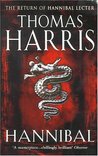
Review of Thomas Harris' Hannibal

Hannibal (Hannibal Lecter, #3)Hannibal by Thomas Harris
My rating: 5 of 5 stars

I kept putting off reading this, because I was afraid of being disappointed after having seen the film. I was NOT disappointed! It was very difficult to put down, and even though I was familiar with the plot and everything from the film, I still found myself wondering how it was going to turn out.

My desire to read this at this moment came mostly from my current writing project. I need some creepy bad guys, and of all in literature, film, etc., Hannibal is one of the first to come to mind in a tie with Cormac McCarthy's creepy creation: Anton Chigur in No Country for Old Men.

Looking forward to reading the rest of the Hannibal Lecter novels and hope they are as much of a charge as this one was.

View all my reviews

Review of Robert Kurzban's Why Everyone (Else) is a Hypocrite

Why Everyone (Else) Is a Hypocrite: Evolution and the Modular MindWhy Everyone (Else) Is a Hypocrite: Evolution and the Modular Mind by Robert Kurzban
My rating: 5 of 5 stars

This is an excellent book on the modular view of the mind. I particular enjoyed the chapters on deception and self-deception.

If you're interested in evolutionary psychology, this is a great book to start an investigation of the subject.


View all my reviews

19 April 2014

Review of Robert Wright's The Moral Animal

The Moral Animal: Why We Are the Way We Are: The New Science of Evolutionary PsychologyThe Moral Animal: Why We Are the Way We Are: The New Science of Evolutionary Psychology by Robert Wright
My rating: 5 of 5 stars

I was introduced to this book during a course on Buddhism and Modern Psychology. Wright covers a lot of ground in this well organized and tightly written book.

Wright doesn't hand down laws, saying "This is how it is," but rather leads with questions and tries to work out the answers based on Darwinian Natural Selection. This is not an easy task; so much is not available when examining the world from a purely materialistic point of view. When one is not allowed to give credit to supernatural, or even non-biological mental events, it really demands a serious and deep interrogation of the biological, chemical, and other physical causes of why people do the things they do. Wright uses several events from Darwin's life as examples, and in doing so makes both evolutionary psychology and Darwinian Natural Selection accessible to his readers.

If you're interested in morality, Darwin, evolutionary psychology, or why people do what they do, this is an excellent read.

If you're not interested in those topics, it's STILL and excellent read! I highly recommend it.

View all my reviews

18 April 2014

Review of Joshua Foer's Moonwalking With Einstein

Moonwalking With EinsteinMoonwalking With Einstein by Joshua Foer
My rating: 5 of 5 stars

Foer uses several examples of how these mnemonic techniques work, and compares/contrasts them to those few people who have unexplained super-memory because of brain damage or brain syndromes. He investigates and includes stories about several people who have such syndromes and are able to do amazing things with their memories, or in some cases, can't remember anything after a few seconds: i.e. they can't develop long-term memories.

Joshua Foer participates in the U.S. memory competition, being trained by one of the top Mental Athletes, as they are called.

Several mnemonic techniques are explained and shown through example. It may be a jump between some of these techniques and real-world application of them, but many can be used immediately in "the real world."

It was a fun read/listen, and if you're interested in the memory, memory competition, mnemonics, memory palaces, or anything like that, I recommend this book. Even if you've read Tony Buzan, Harry Lorayne, Gary Small, Cicero, and others' books on memory, this is a new view on an ancient topic.

Enjoy.

View all my reviews

Get yourself a copy, here:
Moonwalking with Einstein: The Art and Science of Remembering Everything

15 April 2014

Review of Michael Krasny's Spiritual Envy: And Agnostic's Quest

Spiritual Envy: An Agnostic's QuestSpiritual Envy: An Agnostic's Quest by Michael Krasny
My rating: 4 of 5 stars

Krasny asks a book long question (that I shared to some extent), and asks the reader to join the question; he invites the reader to seek along with him. It's probably safe to say that not all agnostics feel the way he feels; but, questioning comes with the territory, I think. Krasny doesn't claim to know the answers. I really appreciate that in this time of such overpowering (sometimes almost nauseating) certainty: in both the believer and atheist camps. Certainty eludes me, as it eludes Krasny, and he isn't afraid to share his uncertainty and what he is doing in spite of it.

Lately, I've had some slight envy, similar to what Krasny writes about, and questions of how to be the best person I can be in this life I have. I don't believe religion is necessary for morality, but I can see how it has shaped morality, mores, and ethics in different societies and for individuals within those societies.

What I miss is the camaraderie that I enjoyed when I was a practicing Christian and that is the envy I have for those who are confident and solid in their faith. Occasionally, I envy the comfort that would come with certainty, but then I remember that if I were certain, I would not have the curiosity to keep my mental hunger fed.

If you are interested in how some agnostics think, this book can help you ask the kinds of questions to find your own way, without telling you how you should think or believe. Read it and see what you think.


View all my reviews

Get yourself a copy, here:
Spiritual Envy: An Agnostic's Quest